


Evidence of Contact
July 9 - July 12, 2026
13 Grattan St, #402, Brooklyn, NY, 11206
Artists
Kyla Liang
Farrell Mason-Brown
Aileen Yujeong Min
Vera Saldivar de Lira
Beatrix Shelton
Jiangyu Huang
Yue Zhou
Curator
Ruotai Tang
New York — P79 Project and A Space Gallery are pleased to present Evidence of Contact, a group exhibition that brings together works beginning with the visible aftermath of contact: surfaces altered by touch, pressure, use, movement, and time. Starting from these material traces, Evidence of Contact looks at how an encounter remains after the action itself has passed. What is left is often partial, unstable, and impossible to fully recover, held instead through images, objects, surfaces, and fragments.
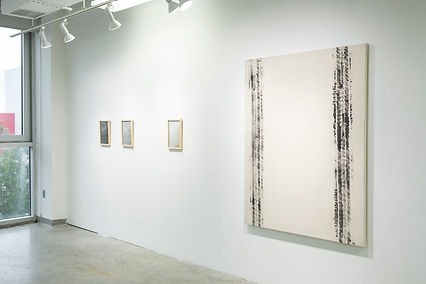
Here, the trace appears as a present condition produced by an earlier encounter. A surface may carry the pressure of a body, the direction of movement, the duration of use, or the slow effects of time. What appears now as a stain, reflection, imprint, covering, or sealed fragment is both a material state and a question of what kind of action, force, or relation produced it.
The exhibition remains in the moment after an event has passed, when the action itself is no longer present but its consequences are still visible. This brings forward the question of how a trace can be read from result back to cause. A tire mark, a shadow, a rubbing, a scanned image, or an accumulated bodily trace does not provide a complete account of what happened, but holds enough material evidence for the earlier contact to remain readable.
Evidence of Contact considers the surface as a site where past actions continue to act in the present. Through altered materials and partial remains, the exhibition approaches contact as a condition that can still be inferred, questioned, and read.
Kyla Liang’s Detour presents a false view framed by a window. The artist places miniature cardboard toys inside plastic packaging, then scans, prints, wraps, and rephotographs the image, allowing the work to carry both the flatness of a scanned image and the spatial distance of a photograph. The “landscape” in the work does not come from a real space, but is constructed through cardboard toys, plastic packaging, and multiple stages of image reproduction. The reflection of the packaging, the flattening effect of the scanner, the printed surface, and the distance created through rephotography all become visible traces within the work. In Evidence of Contact, Detour considers how an image can be produced through contact, copying, and rephotography, becoming a false landscape suspended between object, commodity, and viewing frame.

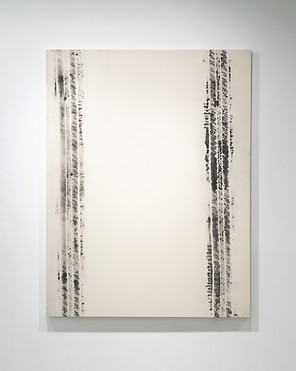
Farrell Mason-Brown’s work presents a stretched canvas marked by two parallel tire tracks. The image suggests that a car has driven across the painting, but the marks are made through a deliberate printing process: the artist coats a car tire with ink and transfers its trace onto the canvas. Referencing Robert Rauschenberg’s Automobile Tire Print, made in collaboration with John Cage, Brown places this gesture within a painting context. A mark usually found on streets, parking lots, or construction sites is moved onto a stretched canvas, shifting from an overlooked trace of daily movement into an image meant to be preserved and viewed. In Evidence of Contact, the work considers how contact can be constructed as an image. The tire tracks simulate the evidence of movement, while also asking how value changes when a mark moves from the street to the canvas.
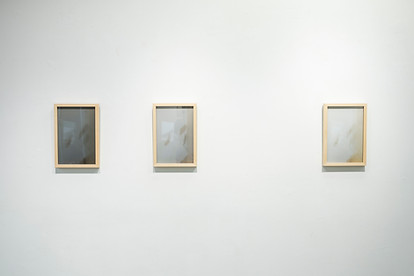
Aileen Yujeong Min’s work presents a series of images composed of botanical shadows. The work begins with plant shadows cast across an interior wall. Min first photographs these brief appearances, then continues to work with them through digital collage, extending the temporary relationship between object, light, and wall. In this series, the shadow becomes an image in continuous change. Through layering and digital processing, the shadow fades, drifts, and returns in altered forms. It gradually separates from the object that produced it, while still carrying the trace of that object’s presence. In Evidence of Contact, Min treats shadow as a quiet form of evidence. It records a brief relation between plant, light, and wall, then transforms that record into residue, memory, and imagined space. What remains is not the object itself, but the visible afterimage of a contact that has already passed.
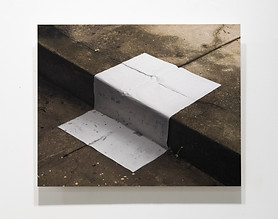
Vera Saldivar de Lira’s work begins with the act of rubbing fine art paper against surfaces encountered in everyday places and objects. The paper records texture, pressure, and geometry through touch, and is then photographed within the same context where the imprint was made. Through this process, the work places rubbing and photography in relation to one another: the paper carries a direct physical impression of the surface, while the photograph records the paper’s return to that site. For Saldivar de Lira, these imprints become a way of marking presence within spaces passed through repeatedly, especially during daily commutes. Surfaces that might otherwise be overlooked become records of contact, movement, and attention. In Evidence of Contact, the work considers touch as a recording device, using imprint, paper, and photograph to question how a place is remembered: through direct physical contact, through an image, or through the shifting relation between the two.
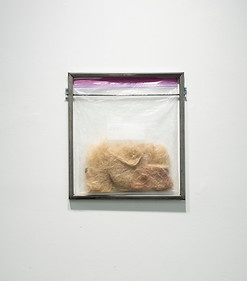
Beatrix Shelton’s work begins with a private ritual of collecting her own shed hair over the past three years. The sculpture incorporates the original plastic Ziploc bag that has held this growing collection, preserving not only the hair itself, but also the everyday system through which it has accumulated. By framing the bag, Shelton shifts an ordinary container into the space of display, while allowing it to remain functional: it can still be opened, closed, and added to. The work therefore stays unfinished, continuing to grow with the body that produces it. Hair, usually discarded, becomes an object of sustained attention through storage, accumulation, and framing. In Evidence of Contact, the sculpture approaches self-portraiture through material accumulation rather than visual likeness, tracing the body through what it sheds, preserves, and continues to produce.
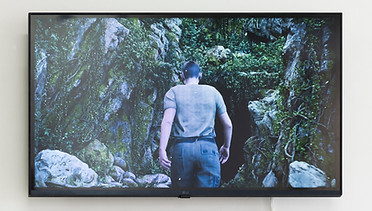
Jiangyu Huang’s Classed Time (2026) is a short film about time, waiting, and class difference. The work follows a puppet boy trapped by a seatbelt in an economy-class cabin that never takes off. Outside the window, a virtual world suggests freedom and movement; inside the cabin, a plant-clock slowly grows across his body. Through stop-motion animation, digital imagery, and the sound of cracking wood, the film creates a slow and repetitive sense of time. In Evidence of Contact, Classed Time approaches waiting as a condition shaped by economic and social position. Time appears not as something equally shared, but as something that can hold a body in place.
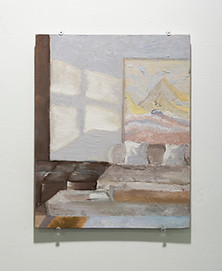
Yue Zhou’s Another Window presents an interior scene where light, wall, and painting create a layered view. A framed mountain landscape appears inside the room, while window-like light falls across the wall, making the boundary between outside and inside less clear. The landscape is not directly seen through a real window, but is carried into the room through painting and light. In Evidence of Contact, the work considers how an image can hold the trace of an encounter between interior space and the outside world, creating a quiet space between reality, memory, and imagined landscape.
Together, the works in Evidence of Contact present different ways contact remains visible after the original action has passed. Through scanned images, tire marks, shadows, rubbings, and accumulated bodily traces, the exhibition moves between direct impressions and mediated forms of evidence, between physical residue and preserved images. What remains is not the event itself, but the surfaces, objects, and fragments through which it can still be read.